Resources & Insights · Market News
Why BDT Payment Routes Are Tightening: What Merchants Should Know in 2026
Key Takeaways
- Merchant interest in BDT payment solutions is rising sharply, driven by Bangladesh's digitally active population and growing mobile wallet usage.
- Regulators are intensifying scrutiny on digital payments, increasing monitoring of mobile financial-service accounts and pursuing networks linked to unauthorized activities.
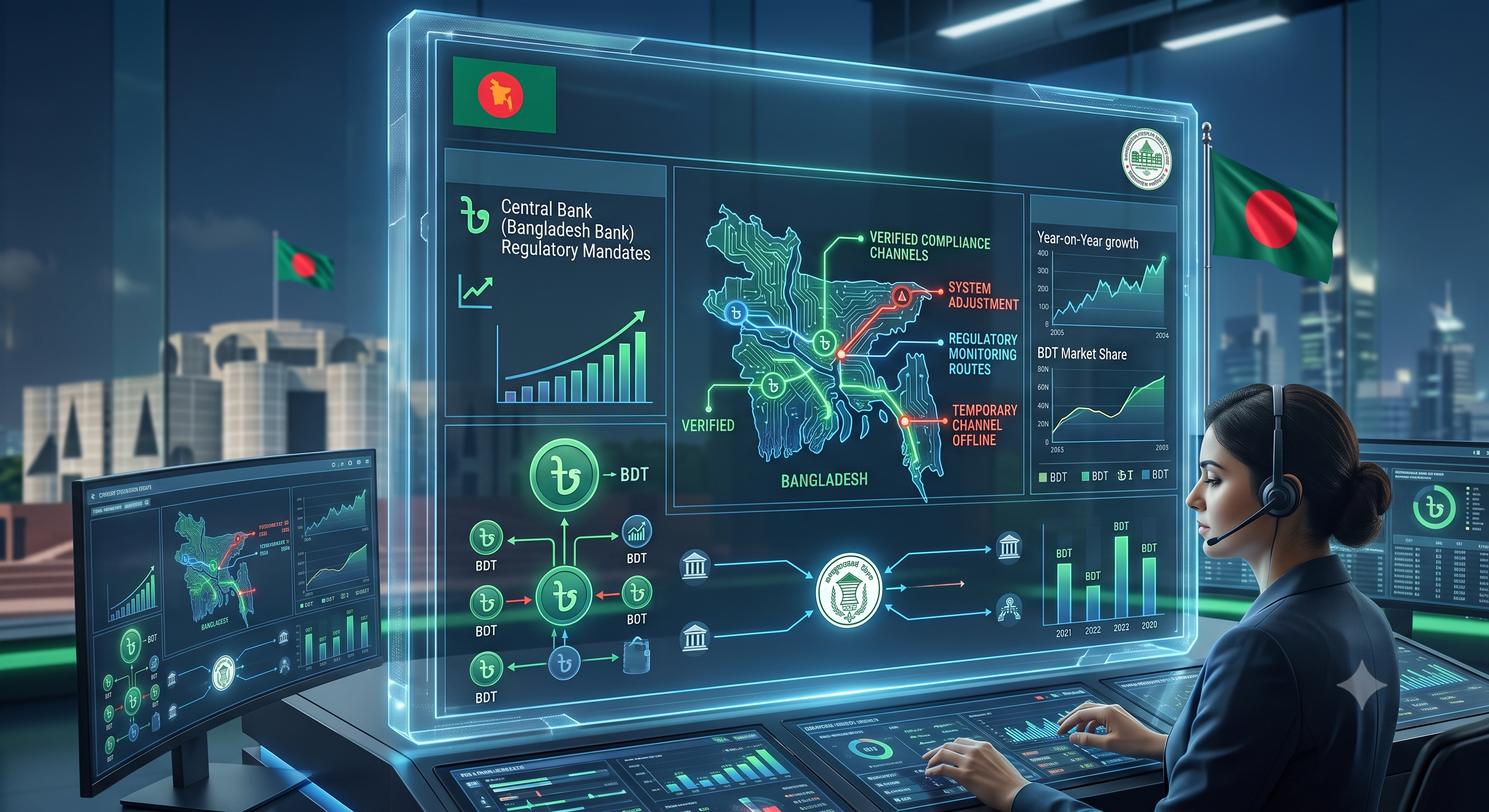
- Temporary maintenance and reduced route availability occur as local providers revalidate accounts, update monitoring rules, and restructure operations to meet stricter compliance.
- Rising BDT payment rates reflect the increased operational costs of maintaining stable networks, enhanced fraud controls, and broader macroeconomic pressures.
- To secure reliable deposit and payout flows, merchants must build redundant, multi-route payment strategies rather than relying on a single provider.
Interest in BDT payment solutions has risen sharply in recent days, with more international merchants looking for reliable ways to process deposits and payouts in Bangladesh.
At the same time, parts of the market are experiencing temporary maintenance, tighter availability and upward pricing adjustments.
These developments appear to be connected to a broader shift in Bangladesh’s digital-payment environment: stronger regulatory scrutiny, increased monitoring of mobile financial-service accounts and a greater focus on transaction transparency.
Bangladesh Is Strengthening Oversight of Digital Payments
Bangladesh has one of South Asia’s most active mobile financial-service ecosystems. Local consumers commonly use bank transfers, mobile wallets and other domestic payment methods for everyday transactions.
As digital-payment volumes grow, regulators and law-enforcement agencies have also increased their focus on how these channels are being used.
In July 2026, Bangladeshi authorities reported the arrest of individuals allegedly involved in an online gambling payment network. Investigators also seized thousands of SIM cards reportedly connected to mobile financial-service accounts.
Bangladesh has separately been developing stronger legislation that could allow courts to close bank accounts, mobile financial-service accounts, payment gateways, digital wallets and other financial channels associated with prohibited gambling activity.
For payment providers, this means transaction monitoring, account verification and merchant-risk reviews are becoming increasingly important.
Why Some BDT Vendors May Be Under Maintenance
When regulatory scrutiny increases, local payment providers may temporarily reduce capacity while they review their networks.
This can include:
- Revalidating collection and payout accounts
- Reviewing agents and local payment partners
- Updating transaction-monitoring rules
- Introducing stricter customer and merchant checks
- Replacing accounts affected by compliance reviews
- Adjusting settlement and liquidity arrangements
Vendors may describe these interruptions as maintenance because the underlying work often involves a combination of technical changes, account reviews and operational restructuring.
These measures can temporarily reduce the number of active BDT payment routes available to merchants.
Why BDT Payment Pricing May Increase
Higher pricing does not necessarily mean the value of the Bangladeshi taka has suddenly become unstable.
In many cases, payment pricing reflects the operational risk and availability of the underlying collection network.
When fewer stable routes are available, providers may face higher costs relating to:
- Compliance and transaction monitoring
- Local account management
- Agent replacement
- Settlement liquidity
- Failed or delayed transactions
- Enhanced fraud controls
- Operational reserves
Providers that continue processing during periods of tighter oversight may therefore adjust their rates to reflect the increased cost of maintaining a stable route.
Macroeconomic Pressure Is Also Affecting the Market
Bangladesh continues to face inflationary, fiscal and banking-sector pressures. The International Monetary Fund said in July 2026 that the country was experiencing significant financial and inflationary challenges, alongside stress in the banking system and pressure from higher import and commodity costs.
The IMF has also encouraged Bangladesh to maintain exchange-rate flexibility, rebuild foreign-exchange reserves and continue restructuring its banking sector.
These broader conditions may not directly cause payment-channel maintenance, but they can influence liquidity management, settlement appetite and the pricing offered by local financial partners.
Why Merchant Demand for BDT Is Growing
Despite the short-term tightening of some payment channels, merchant interest in Bangladesh remains strong.
Bangladesh has a large, digitally active population and a rapidly developing financial ecosystem. Growing use of mobile wallets, instant transfers and online services continues to make BDT an important market for regional and international merchants.
Demand is particularly strong among businesses that need:
- Local BDT deposit collection
- Fast customer payouts
- Mobile-friendly payment methods
- Local settlement capabilities
- Higher transaction-success rates
- Redundant payment-provider coverage
As more merchants enter the market, reliable BDT processing capacity becomes more valuable.
What Merchants Should Expect
During periods of heightened review, merchants should prepare for changing route availability.
A BDT payment provider that is working normally today may temporarily reduce volume tomorrow. Pricing may also differ significantly between providers depending on their account structure, liquidity and compliance controls.
Merchants should avoid relying on a single payment route and instead build redundancy into their Bangladesh payment strategy.
Important factors to monitor include:
- Deposit and payout success rates
- Available processing limits
- Settlement timing
- Maintenance frequency
- Account stability
- Provider response times
- Compliance requirements
- Backup-route availability
Building a More Resilient BDT Payment Strategy
A stable BDT payment setup requires more than simply finding the lowest rate.
Merchants should work with payment partners that can actively manage multiple providers, monitor route performance and move volume when a particular channel becomes unstable.
At Help2Pay, we continuously monitor local payment conditions and work with our partners to maintain dependable deposit and payout coverage across Asian markets.
Our approach focuses on:
- Multiple local payment connections
- Active route-performance monitoring
- Backup processing options
- Transparent merchant communication
- Competitive and sustainable pricing
- Fast response to local market changes
The Outlook for BDT Payments
The recent rise in BDT inquiries highlights the growing commercial importance of Bangladesh.
In the near term, stronger regulatory controls may create temporary maintenance, tighter capacity and higher prices across certain providers. Over the longer term, improved transaction monitoring and more resilient payment infrastructure could create a stronger and more sustainable local payment market.
For merchants, the priority should be to secure reliable BDT coverage before capacity becomes constrained.
Businesses interested in Bangladesh payment processing can contact Help2Pay to discuss BDT deposits, payouts and alternative local payment routes.
This article provides general market commentary based on publicly available information. It should not be interpreted as confirmation that any individual payment provider or merchant is connected to the enforcement actions discussed.
Ready to build a resilient BDT payment strategy?
Secure dependable deposit and payout coverage across Asian markets with multiple local connections and active performance monitoring.
Frequently asked questions
Why are some BDT payment routes currently under maintenance?
Increased regulatory oversight has prompted providers to temporarily reduce capacity while they revalidate collection accounts, introduce stricter customer checks, and update transaction-monitoring rules.
Why are BDT payment processing fees increasing?
Higher pricing reflects operational risk and the cost of maintaining stable networks, rather than sudden currency instability. Providers are adjusting rates to cover compliance, agent replacement, settlement liquidity, and enhanced fraud controls.
How can international merchants ensure stable BDT processing?
Merchants should avoid single points of failure by building redundancy into their payments setup. Partners like Help2Pay manage multiple local connections, actively monitor route performance, and shift volume to backup channels during market fluctuations.